
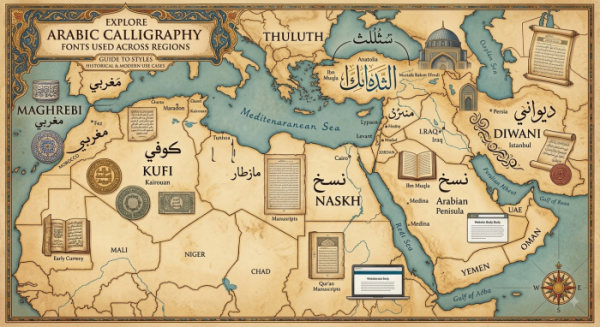
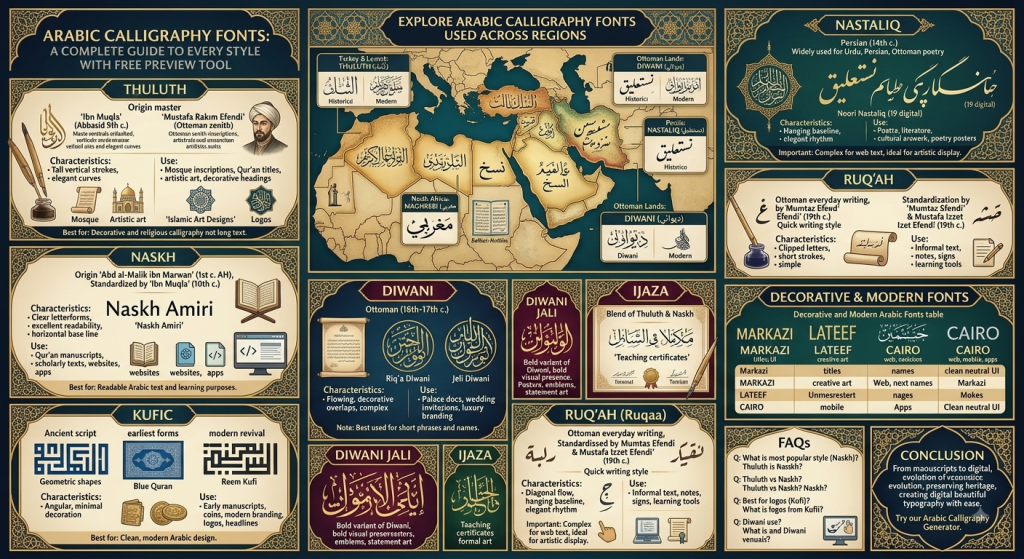
Arabic Calligraphy Fonts: A Complete Guide to Every Style With Free Preview Tool
Origins, History and Modern Use Cases:
Arabic calligraphy is one of respected art forms most in Islamic and Eastern Middle culture. Over centuries, different scripts evolved to serve religious, administrative, literary and artistic purposes. Today these classical styles are preserved and adapted into fonts digital, allowing users to create Arabic calligraphy online with ease.
This guide explains the origin, evolution and modern use cases of most popular Arabic calligraphy fonts used in digital tools and design. history of Arabic calligraphy
Thuluth Scheherazade:
Origin
Thuluth was first invented by the polymath and calligrapher master Ibn Muqla during Islamic Golden Age. Enormous contributions to evolution of the Thuluth occurred script in the Ottoman Empire in three successive steps that Ottoman art historians call “calligraphical revolutions”:

The best known artist write the Thuluth script at its zenith is said to be Mustafa Rakım Efendi (1757–1826) a painter who set standard in calligraphy Ottoman which many believe has not been surpassed to this day.
Thuluth emerged in 9th century during the Abbasid era and was later refined by Ottoman calligraphers. The name “Thuluth” means one third referring to specific pen proportions.
Key Characteristics:
Traditional Use:
Modern Use:
Best for Decorative and religious calligraphy not long text. Thuluth vs Naskh comparison
References:
- “Hüseyin Kutlu: Hat sanatı kalemi şevk edebilmektir – Kalem Güzeli”. www.kalemguzeli.org. Retrieved 17 April 2018.
- Pritchett, Frances. “hamdullah1500s”. www.columbia.edu. Retrieved 17 April 2018.
Naskh Amiri
Origin:
The Naskh style of writing can be found as early as within the first century of the Islamic calendar. It was established at this time by order of Abd al-Malik ibn Marwan due to the presence of defects in the Kufic script.
Ibn Muqla is credited with standardizing the “Six Pens” of Islamic calligraphy, also including thuluth, tawqi’, riqaaʿ, muhaqqaq, and rayhani. These are known as “the proportioned scripts” (al-khatt al-mansub) or “the six scripts” (al-aqlam al-sitta)
Naskh became standardized in the 10th century and is the most widely used script for Arabic manuscripts. The Amiri font is a modern revival of classical Naskh.

Description
The alif is written as a straight stroke, bending to the lower left. Naskh differentiates various sounds through the use of diacritical points, in the form of 1–3 dots above or below the letter, which makes the script more easily legible. Naskh uses a horizontal base line; in situations where one character starts within the tail of the preceding letter, the base line is broken and raised. In sixteenth-century Constantinople, Şeyh Hamdullah (1429–1520) redesigned the structure of naskh, along with the other “Six Pens”, in order to make the script appear more precise and less heavy.
Key Characteristics
Traditional Use
Modern Use
Best for: Readable Arabic text and learning purposes.write your name in Arabic
References
- Blair, Sheila (2006). Islamic calligraphy. Edinburgh University Press. ISBN 9780748612123.
- Roxburgh, David J. (2007). Writing the word of God: calligraphy and the Qur’an. Houston: Museum of Fine Arts, Houston. ISBN 9780300142006. OCLC 180190749.
Explore Arabic Calligraphy Fonts Used Across Regions
Noto Naskh Arabic
Origin
Developed by Google’s Noto Project Noto Naskh Arabic ensures proper Arabic rendering devices across and platforms.

Key Characteristics:
Use Cases:
Why it matters: Ensures consistent Arabic text display globally.
Learn Which Arabic Calligraphy Font to Practice
Reem Kufi (Kufi)
Origin
Calligraphers in the early Islamic period used a variety of methods to transcribe Quran manuscripts. Arabic calligraphy became one of the most important branches of Islamic Art. Calligraphers came out with the new style of writing called Kufic. Kufic is oldest calligraphic form of various Arabic scripts. The name of script derives from Kufa a city in southern Iraq which was considered as an intellectual center within the early Islamic period.

Inspired by ancient Kufic script 7th century, Reem Kufi is a modern, simplified interpretation.
One impressive example of an early manuscript Quran, known as the Blue Quran, features gold Kufic script on parchment dyed with indigo. It is commonly attributed to early Fatimid or Abbasid court.
Key Characteristics:
Traditional Use
Modern Use
Best for: Clean, modern Arabic design.
References
- Déroche, François. Catalogue des manuscrits arabes. Deuxième partie: manuscrits musulmans, Tome I, 1. Les manuscrits du Coran. Aux origines de la calligraphie coranique (Paris: Bibliothèque Nationale, 1983), pp. 41–45.
- D’Ottone Rambach, Arianna (January 2017). “The Blue Koran. A Contribution to the Debate on its Possible Origin and Date”. Journal of Islamic Manuscripts. 8 (2). Leiden: Brill Publishers: 127–143. doi:10.1163/1878464X-00801004. S2CID 192957200.
Diwani
Origin
Diwani is calligraphic variety of Arabic script a cursive style developed during reign of the early Ottoman Turks 16th century – early 17th century. It reached its height of popularity under Süleyman I the Magnificent (1520–1566).
Developed during the Ottoman Empire Diwani was used in royal courts and official correspondence.

The Diwani script can be divided into two types:
Key Characteristics
Traditional Use
Modern Use
Note: Best used for short phrases and names.
References
- Osborn, J.R. (2009). “Narratives of Arabic Script: Calligraphic Design and Modern Spaces”. Design and Culture. 1 (3): 289–306. doi:10.1080/17547075.2009.11643292. S2CID 147422407.
Ijaza
Origin
Ijaza is blend of Thuluth and Naskh traditionally used for scholarly certifications.

Key Characteristics:
Traditional Use
Modern Use
Diwani Jali
Origin
A bold and decorative variant of Diwani, used for imperial emphasis.

Key Characteristics:
Modern Use
Shekasta
Origin
A Persian script developed for fast writing in administrative contexts.

Key Characteristics:
Modern Use
Nastaliq
Origin
Nastaliq is one of the main calligraphic hands used to write Arabic script and is used for some Indo-Iranian languages, predominantly Classical Persian, Urdu, Kashmiri and Punjabi. It is often used also for Ottoman Turkish poetry, but rarely for Arabic. Nastaliq developed in Iran from naskh beginning in the 13th century and remains widely used in Iran, India, Pakistan, Afghanistan and other countries for written poetry and as a form of art.
Developed in 14th century Nastaliq Persia is widely used for Urdu and Persian.
The name Nastaliq “is a contraction of the Persian naskh-i ta’liq (Persian: نَسْخِ تَعلیق), meaning a hanging or suspended naskh.” Virtually all Safavid authors like Dust Muhammad or Qadi Ahmad attributed invention of nastaliq to Mir Ali Tabrizi, who lived at the end of 14th and the beginning of 15th century.

Nastaliq typesetting
Modern Nastaliq typography began with the invention of Noori Nastaliq which was first created as a digital font in 1981 through the collaboration of Ahmed Mirza Jamil (as calligrapher) and Monotype Imaging (formerly Monotype Corp & Monotype Typography).
Akram, Qurat ul Ain, Hussain, Sarmad, Niazi, Aneeta, Anjum, Umair, Irfan, Faheem (April 2014).
Traditional Use
Modern Use
Important: Complex for web text, ideal for artistic display. generator kaligrafi Arab gratis
References
- Akram, Qurat ul Ain; Hussain, Sarmad; Niazi, Aneeta; Anjum, Umair; Irfan, Faheem (April 2014). “Adapting Tesseract for Complex Scripts: An Example for Urdu Nastalique”. 2014 11th IAPR International Workshop on Document Analysis Systems. 11th IAPR International Workshop on Document Analysis Systems. Tours, France: IEEE. pp. 191–195. doi:10.1109/DAS.2014.45. ISBN 978-1-4799-3243-6.
- “Nastaliq”. Lexico Dictionaries. Oxford University Press. Archived from original on March 28, 2022. Retrieved 2020-07-05.
How Arabic Names Are Written in Calligraphy.
Ruqaa (Ruq‘ah)
Origin
Ruqʿah (Arabic: رُقعة) or Riqʿah (Arabic: رِقعة) is a writing style of Arabic script intended for the rapid production of texts. It is a relatively simple and plain style, used for everyday writing and often used for signs.The Ottoman calligraphers Mumtaz Efendi (1810–1872) and Mustafa Izzet Efendi (1801–1876) are credited with standardizing the writing style which had existed in slightly different styles as everyday handwriting.
An Ottoman script designed for speed and everyday handwriting.

Description and usage
Ruqʿah is the most common type of handwriting in the Arabic script. It is known for its clipped letters composed of short, straight lines and simple curves, as well as its straight and even lines of text. It was probably derived from the Thuluth and Naskh styles.
Unlike other types of calligraphy, ruqʿah is not considered as an art form. Instead, it is a functional style of writing that is quick to write and easy to read. Every literate Ottoman was expected to be able to use the ruqʿah.
The demonstration below is not typical since it uses full vowels, which are rarely used in handwriting:


Key Characteristics:
Modern Use
References
- Nemeth, Titus (2017). Arabic type-making in the Machine Age. The influence of technology on the form of Arabic type, 1908–1993. Brill. ISBN 978-90-04-30377-5. OCLC 993032900.
- “Hattat Ebûbekir Mümtâz Efendi kimdir? Ebûbekir Mümtâz Efendi hayatı ve eserleri – Ketebe”. www.ketebe.org. Retrieved 5 May 2022.
Markazi (Decorative)
Origin
A modern decorative Arabic style influenced by classical proportions.

Use Cases
Lateef (Diwani-like)
Origin
Designed for Arabic and Urdu, inspired by handwritten styles.

Use Cases
Cairo (Modern)
Origin
A contemporary Arabic sans-serif font developed for digital use.

Key Characteristics
Use Cases
Best for: Modern digital Arabic content.
Decorative and Modern Arabic Fonts:
| Font | Origin | Use Cases | Key Features |
|---|---|---|---|
| Markazi | Modern decorative | Titles, UI elements | Classical proportions, stylized |
| Lateef | Inspired by Diwani | Creative calligraphy, artistic names | Handwritten style, informal typography |
| Cairo | Contemporary sans-serif | Websites, apps, UI, branding | Clean, neutral, high readability |
For designers and interested scripts learners in classical beyond Arabic tradition, exploring regional Arabic calligraphy styles such as Jawi, Khat, Nastaliq Urdu and reveals Kufi how Arabic evolved script differently across fourteen centuries of exchange culture.
Conclusion:
Thuluth to Nastaliq Arabic calligraphy has evolved from sacred manuscripts to digital modern fonts. Each style carries its own history, aesthetics and use practical, whether religious texts, tools educational, design digital or creative projects. learn Arabic calligraphy
Learning these online fonts allows anyone to explore Arabic art, preserve heritage culture and create digital beautiful typography with ease.
Try our Arabic Calligraphy Generator.
Frequently Asked Questions:
What is most popular Arabic calligraphy style ?
Naskh is most Arabic popular calligraphy style because it readable highly and used widely in books, websites and Arabic printed text. It forms the foundation of Arabic modern typography.
What is difference between Thuluth and Naskh ?
Thuluth is a Arabic decorative calligraphy style with large, letters curved used in artistic and architectural designs, while Naskh is simpler, smaller and designed for readability in everyday writing and print.
Which Arabic calligraphy style is best for logos ?
Kufi is considered the best Arabic calligraphy style for logos due to its shapes geometric and strong visual structure, making it ideal for modern branding and design.
What is Diwani calligraphy used for ?
Diwani calligraphy is used traditionally for royal decrees, official documents, and designs decorative such as wedding invitations and branding luxury due to its elegant and flowing style.