Learn Arabic Calligraphy Online — Complete Beginner Guide 2026
There has never been a time to learn arabic calligraphy better online. Between high-quality online tutorials, dedicated learning platforms, free digital tools and a community of practitioners global sharing their work every day, the barriers that once made this art form seem have largely disappeared inaccessible. Whether you live in Karachi or Chicago, whether you have been your whole life drawing or you have never considered yourself artistic you can learning today with start nothing more than a pen, some paper and a screen.beginner’s calligraphy guide
This guide gives you everything you need to begin — the context to understand what you are learning, the styles to choose from, the tools to use, and a structured plan to take you from complete beginner to confident practitioner over eight weeks.
Complete beginner Arabic calligraphy learning guide
Why learn arabic calligraphy online in 2026?
Interest in Arabic calligraphy has steadily over grown the past decade as demand for authentic global Arabic design has expanded. Arabic-speaking markets the Middle East across , North Africa and South Asia hundreds of millions represent of consumers and brands, designers and artists working in these need people regions who can produce genuine, culturally resonant calligraphic work.
commercial opportunity Beyond , Arabic calligraphy offers something rarer — a connection direct to one of the world’s most artistic traditions enduring . The scripts you practice today use the proportional systems same and letter structures developed by masters over a years ago thousand . There is a meditative, quality to this grounding kind of practice that many people deeply valuable find in an otherwise fragmented digital world.
For those interested in the dimension freelance , skilled Arabic calligraphers can between fifty earn and two hundred dollars per custom design, with personalised name pieces, wedding invitations, and logo work forming the most consistent demand. Building a small of genuine portfolio skill opens real income opportunities through platforms like Etsy, Instagram and client work direct.
The 5 Important Arabic Calligraphy Styles Most
Arabic calligraphy of regional encompasses dozens and historical styles but five dominate modern learning and application practical. Understanding the of each one personality helps you choose where to start and where to go next. all 13 Arabic calligraphy styles
Naskh — The Foundation
The most used Arabic script in the world widely. Naskh is the basis of printed Arabic in books text, newspapers, websites and interfaces digital. Its letterforms are balanced, clear and governed by proportional precise rules that make it the foundation ideal for all learning calligraphy . Begin here.
Thuluth — The Master Style
The benchmark of classical Arabic calligraphy. Thuluth features large, dramatically sweeping forms with complex proportional relationships. It dominates decorations mosque, Quranic inscriptions and high-prestige calligraphic works. This is the style that dedicated students separates from casual learners — mastering it is a significant that typically takes achievement three to five years of focused study.
Diwani — Elegance and Flow
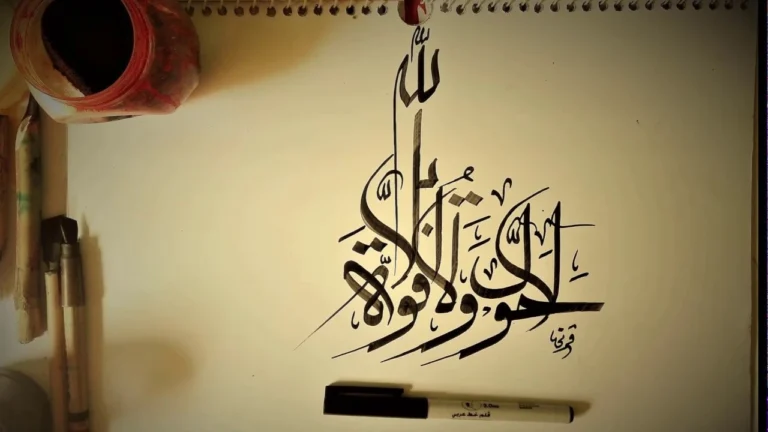
Developed in imperial Ottoman court in the 16th century, Diwani is characterised by its fluidity extreme and curves ornamental. Letters connect in arcing forms dramatic that feel almost musical in movement their. Diwani is the style most people picture when they think of Arabic calligraphy at its romantic and decorative most. It is particularly popular for name art, wedding invitations, and gift items personalised.
Ruq’ah — Everyday Beauty
Ruq’ah developed as a practical everyday handwriting style and it shows — letters are simplified, efficient, and quick to write without sacrificing elegance. Across the Arab world, Ruq’ah is what educated people write by hand. For those interested in practical handwriting improvement rather than formal calligraphic art, Ruq’ah is the most immediately useful style to study.Jawi and Khat traditions
Nastaliq — The Pride of South Asia
The definitive script for Urdu and Persian calligraphy. Nastaliq’s dramatic diagonal flow — where each word cascades gently downward from right to left — gives it a visual beauty that is genuinely unlike anything else in the Arabic calligraphy family. It is the of poetry language, of longing, of South Asian literature classical. If your connection to Arabic calligraphy comes through Urdu, Persian or Asian heritage Nastaliq South is where you belong.
Free Online Tools to Support Your Learning
The right digital tools do not replace practice — they accelerate it. Correctly used allow online resources you to study examples before attempting professional to them recreate hand by, which is exactly how apprentices traditional learned master calligraphers from.
The Arabic Calligraphy Generator lets you type any word or name and see it in multiple authentic rendered calligraphy instantly styles. This is invaluable for studying how letters connect in a specific word, what the finished target should look like, and how different styles treat the same text differently. Use it as your reference point before and during hand practice.
YouTube has become an extraordinary resource for calligraphy learners. Channels run by working calligraphers in Turkey, Egypt, Pakistan, and Malaysia regularly post detailed instruction videos showing stroke formation, tool preparation, and complete compositions being created in real time. Watch these on a tablet beside your practice surface so you can pause and refer to them continuously.
For structured practice sheets, several dedicated websites offer free downloadable worksheets with letter guides and tracing templates for Naskh and other common styles. These are particularly valuable in the first month when you are building muscle memory for the basic letter forms.
How to Use a Generator as a Learning Tool
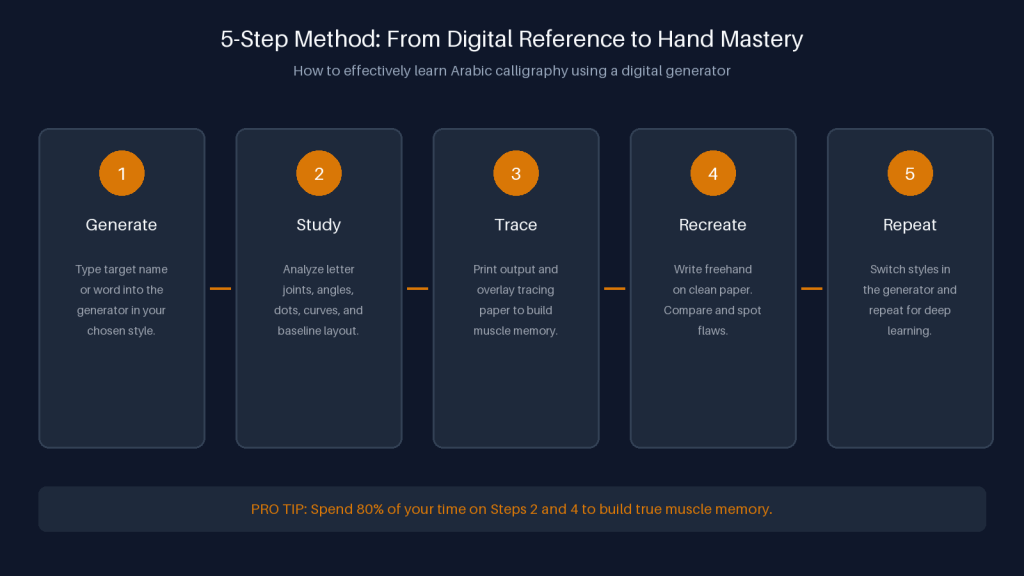
Most beginners use calligraphy generators only to produce finished outputs. But they are also powerful study tools when used with intention. Here is a five-step process that bridges digital tools and genuine hand skill.
Step 1 — Generate your target word: Type a short word — your name, or a simple meaningful word — into the generator and select your chosen style. Download or screenshot the output.
Step 2 — Study the structure: Before touching a pen, spend five minutes examining the generated output. Identify where individual letters begin and end. Notice the connecting strokes. where curves Observe are tight versus open, where dots are positioned and how the sits word on baseline.
Step 3 — Trace on paper: Print the generated word and place tracing paper over it. Trace the letter forms slowly and deliberately with a calligraphy pen. This builds hand memory for the correct shapes before you attempt them freehand.step-by-step design tutorials
Step 4 — Recreate freehand: Put the tracing paper aside and attempt the word freehand on clean paper. Compare your attempt with the generated original. Identify the specific strokes that need improvement.
Step 5 — Repeat with variations: Try the same word in a different style using the generator, then repeat the study-trace-recreate process. Over time you will develop an intuitive understanding of how each style shapes its letters differently.
Your 8-Week Online Learning Plan
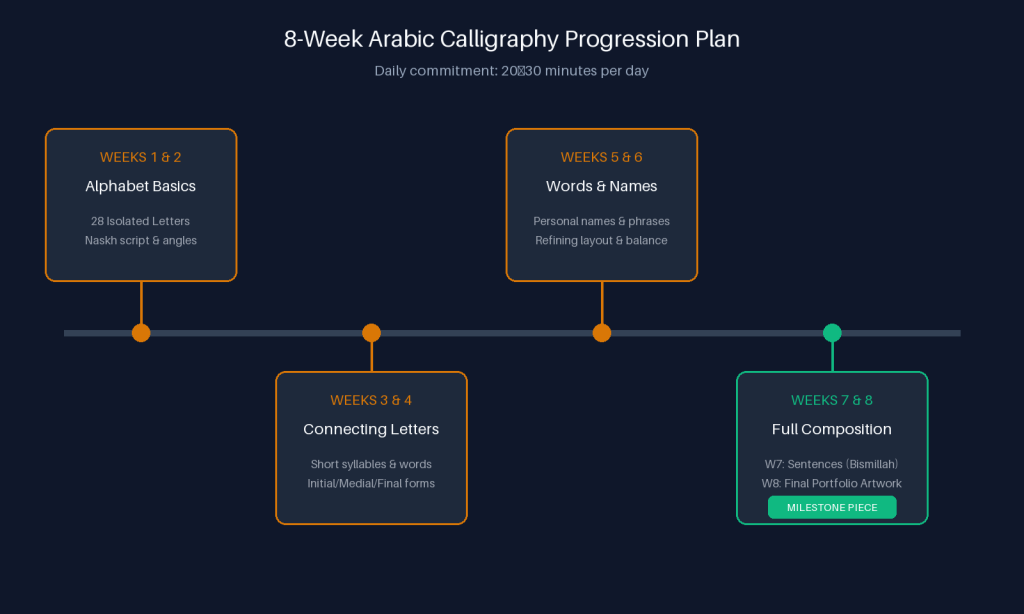
Structure is the single biggest factor in how quickly people progress. This plan requires 20 to 30 minutes per day and takes you from knowing nothing to producing your first complete calligraphic piece.
Weeks 1 and 2 — Master the Arabic Alphabet: Learn all 28 letters in forms isolated their using Naskh style. Focus on stroke, pen angle and proportions basic. Use a generator to study the correct form of each letter before practicing. direction Write each letter a minimum of 15 times per session. Do not move on until each letter feels familiar.
Weeks 3 and 4 — Practice Naskh Basics: Begin letters connecting into short syllables and words simple. Study how letter change shapes at the beginning, middle and of words end. Common two and three letter words are ideal at this stage. Use your generator reference constantly during this phase.
Weeks 5 and 6 — Short Words and Names: Move to writing common names and meaningful short phrases. Personal names are practice excellent material because they carry emotional investment that keeps motivation high. Try writing your own name in Arabic calligraphy and refining it across multiple sessions.
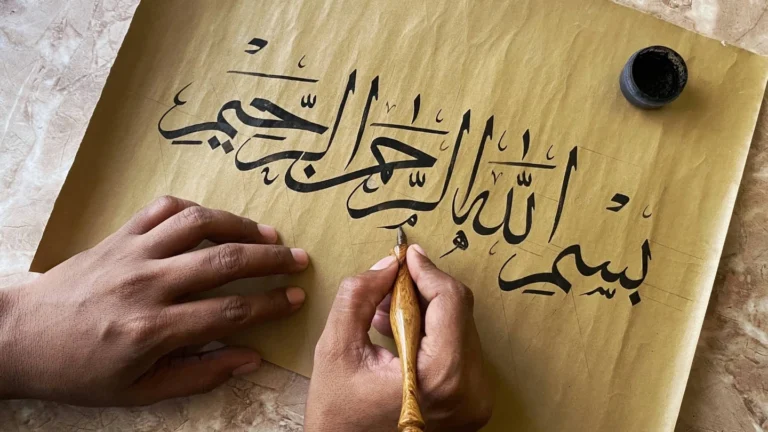
Week 7 Your First Full Sentence: Attempt a short sentence or phrase in Naskh. The Bismillah phrase opening of the Quran, used in many contexts culture is a first traditional complete composition for students calligraphy because it contains a wide variety of letter forms and connections.
Week 8 Create Finished Piece: Produce one complete calligraphic composition that you are proud of genuinely . Use your best paper, your best ink, take your time and approach it as finished artwork rather than practice. This piece becomes foundation of your portfolio.
Building a Calligraphy Portfolio Online
Once you have small collection of pieces finished, sharing them accelerates online both your learning and your opportunities. Instagram is by far most effective platform for artists calligraphy suits visual the work perfectly and community of calligraphers and enthusiasts is large, active and genuinely supportive. Consistently Posting, even just twice week, builds an audience over time.
Significant Pinterest drives long term traffic to work calligraphy because pins surface in search results for years after posting. A single strong image can generate tens of thousands of impressions over its lifetime. Etsy is the natural home for selling finished pieces, printable artwork, and custom name calligraphy — a well-presented listing of personalised Arabic name calligraphy can become a consistent source of income with relatively little maintenance once established.
Your first ten portfolio pieces should demonstrate range — different styles if possible, different types of content (single letters, words, names, short phrases), and different compositions. Quality matters more than quantity at this stage.
The Artistic Legacy of Arabic Script
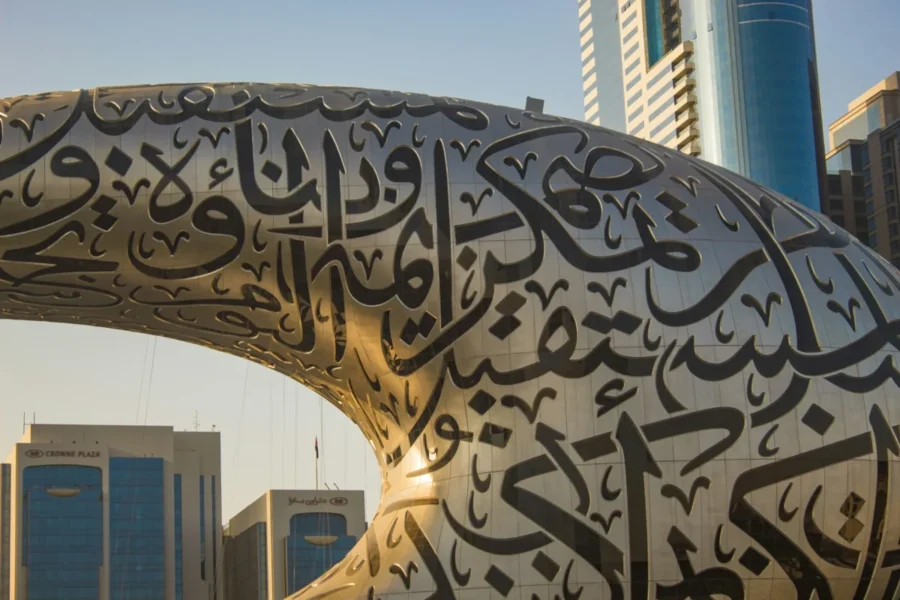
Arabic calligraphy is more than a writing system it’s a cultural form with over a millennium of history. From domes mosque to modern logos, it conveys spiritual depth and aesthetic precision.
Key points:
- The alphabet Arabic has 28 letters written right to left.
- Letters shape change depending on their position initial, medial, final or isolated.
- Calligraphy transforms letters into art, balance highlighting, flow and rhythm.
Modern digital tools capture these rules artistic, helping learners appreciate the beauty of form without traditional pens or ink.
Why Use Calligraphy Generators to Learn Arabic Script:
Traditional calligraphy requires years of practice, hands steady and specialized tools. Online generators make learning easier and more engaging.
Benefits:
- Instant Visual Feedback Type any Arabic or English transliteration and see calligraphic form immediately.
- Easy Transliteration Type “Salam” → “سلام” peace to practice pronunciation and recognition.
- Style Exploration Try Thuluth, Diwani, Naskh and Kufic for understand cultural and differences artistic.
- Engagement Educational Teachers can create worksheets, posters and exercises tracing for interactive learning.
3. Getting Started Learning Arabic Script Online:
Step 1: Choose Reliable Tool
Start with a generator that supports both Arabic and English input. The Arabic Calligraphy Generator is friendly beginner, free and works on all devices. Thuluth vs Naskh for beginners
Step 2: Begin with Simple Words
Start with words meaningful like:
- سلام (Salam) peace
- حب (Hubb) love
Step 3: Explore Calligraphy Styles:
| Style | Description | Ideal for |
| naskh | Readable and clear | beginners |
| thuluth | Elegant and decorative | Art Projects |
| diwani | Flowing and intricate | Creative Writing |
| kufic | Angular/geometric | Logos and Design |
Step 4: Observe Letter Connections and Stroke Flow
Type letters alone and in words to study how strokes merge essence of Arabic beauty.
Step 5: Customize, save and Print
- Adjust colors, stroke thickness and backgrounds
- Export as PNG or SVG for printing or tracing
- Build digital alphabet poster to track progress
How Calligraphy Generators Support Education:
For Teachers:
- Create interactive visuals and flashcards
- Use transliteration for pronunciation teaching
- Design worksheets for tracing and repetition
For Students:
- Practice writing with instant guidance
- Compare multiple styles
- Retain vocabulary longer through artistic engagement
Transliteration: Bridging English and Arabic
Calligraphy generators convert Latin script into Arabic instantly:
| English | Arabic | Meaning |
| Allah | الله | God |
| Mohammed | محمد | Prophet Mohammed |
| Jameela | جميلة | Beautiful |
| Noor | نور | Light |
This feature helps learners understand phonetics and develop natural writing flow.video tutorials
Latest Trends in Arabic Calligraphy Learning
Digital Arabic calligraphy continues to evolve:
AI-Powered Learning:
- Suggests optimal stroke flow and style variations
- Helps beginners produce professional-quality designs
Mobile & Tablet Access:
- Learn and create Arabic script anywhere
- Share and save projects instantly calligraphy practice resources
Interactive & 3D Effects:
- Gradient strokes, backgrounds, and 3D embossing for print or social media
- Animate letters for digital presentations
Collaborative Learning:
- Real-time editing for classrooms or online workshops
- Group projects make learning social and interactive
These trends make learning Arabic script faster, more engaging and visually stunning.
Asked Frequently Questions:
Do I need to know how to speak or Arabic read before I start learning calligraphy ?
No, Many accomplished Arabic calligraphers are not Arabic speakers. You are learning to draw beautiful shapes with intention and skill, not to communicate verbally. A basic familiarity with letter names is helpful for following instruction materials, but conversational or reading ability in Arabic is not prerequisite.
How long does it take before I am good enough to sell my work ?
With daily consistent practice, most dedicated students produce sellable work within six to twelve months. The most popular products for new sellers are personalised name pieces — customers value the meaning and personal connection more than perfection. Focus on clean producing, consistent work in one style before diversifying.
Children can learn Arabic calligraphy online ?
Absolutely and many traditional calligraphy begin schools children teaching as young as seven or eight. The structured, nature repetitive of practice calligraphy suits children well and develops fine motor skills, patience, and concentration alongside the artistic learning. A basic felt tip pen calligraphy and practice worksheets are all that is needed to get child started at home.